Andrew Watson About Andrew Watson

Andrew began his classroom life as a high-school English teacher in 1988, and has been working in or near schools ever since. In 2008, Andrew began exploring the practical application of psychology and neuroscience in his classroom. In 2011, he earned his M. Ed. from the “Mind, Brain, Education” program at Harvard University. As President of “Translate the Brain,” Andrew now works with teachers, students, administrators, and parents to make learning easier and teaching more effective. He has presented at schools and workshops across the country; he also serves as an adviser to several organizations, including “The People’s Science.” Andrew is the author of "Learning Begins: The Science of Working Memory and Attention for the Classroom Teacher."

Research Morsel: Digital Media vs. Flourishing
Andrew Watson
Andrew Watson


AdobeStock_97841942_Credit

The Findings: Researchers at Brown University1 have found that increased time spent on “digital media” reduces the likelihood of “flourishing.” For example, students who spent 2-4 hours on digital media were 23% less likely to complete homework than those who spent 0-2 hours.

Those who spent more than 6 hours (!) on digital media were 63% less likely (!!) to finish homework than their 0-2 hour peers.

Screen time impedes other kinds of growth. Extra minutes on digital media reduce the likelihood that students will complete tasks that they have started, or remain calm under pressure.

Surprise #1: This result holds true despite age, gender, or socio-economic status. Stereotypes might suggest, for instance, that girls can handle digital distraction better than boys can, but…at least in this study…not so much.

Nagging Questions:

At least so far, these researchers haven’t reported the effects of meaningful subcategories. Are all kind of digital media equally bad?

After all, other studies have shown cognitive benefits for some video games: for example, Portal2, or Starcraft3. One HUGE study (27,000 French middle schoolers) found that video games had basically no effect on academic performance4.

I also wonder: as teachers increasingly assign homework that might be done on a tablet, what effect does academic digital media time have on these findings? Do our efforts to join our students’ digital lives in fact impede their learning?

Is the problem here simply distraction from schoolwork? For example: if a student spends more than 6 hours a day (!) building snow forts, what effect does that have on the likelihood she will finish her homework?

The research hasn’t been published yet, so we’re still relying on the authors’ own summaries.


  1. American Academy of Pediatrics. (2016, October 21). More time on digital devices means kids less likely to finish homework: Study finds dose-dependent relationship between time spent watching TV, playing video games or using a smartphone and tablet, and the chances a child will regularly finish homework. ScienceDaily. Retrieved November 12, 2016 from sciencedaily.com/releases/2016/10/161021122236.htm
  2. Shute, V. J., Ventura, M., & Ke, F. (2015). The power of play: The effects of Portal 2 and Lumosity on cognitive and noncognitive skills. Computers & Education80, 58-67. [article]
  3. Glass, B. D., Maddox, W. T., & Love, B. C. (2013). Real-time strategy game training: emergence of a cognitive flexibility trait. PLoS One8(8), e70350. [article]
  4. Lieury, A., Lorant, S., Trosseille, B., Champault, F., & Vourc’h, R. (2014). Video games vs. reading and school/cognitive performances: a study on 27000 middle school teenagers. Educational Psychology, 1-36.

On Average, the Average is Off
Andrew Watson
Andrew Watson


AdobeStock_92636720_Credit

Here’s a potential headline:

BOOK ON STATISTICS MAKES GRIPPING READING

Or, another:

COMMONLY USED SCHOOL METRICS MOSTLY USELESS

Or, one more:

LIFE STORY OF FUNNY MAN EXEMPLIFIES MORAL IMPERATIVE

These headlines, perhaps, leave you deeply skeptical. And yet, Todd Rose’s The End of Average fulfills them all. It may be the only book about a basic mathematical procedure that you start recommending to your colleagues.

BOOK ON STATISTICS MAKES GRIPPING READING

As a culture, we’re obsessed with averages: from IQ and GPA, to ERA and on-base percentage, to the Dow Jones and monthly unemployment.

Given the ubiquity of these calculations, it’s amazing to learn that an identifiable individual first decided to use scientific averaging procedures to draw conclusions about human social institutions. (It’s even more amazing to learn that his name was Adolphe Quetelet. This man should have invented potato chips.)

In the 200 years since Quetelet, some have seen the average as the ideal, and vilified variance from the average as a problem that schools and factories must solve.

Others—including Francis Galton, relative of Charles Darwin—have been champions of those who exceeded the average, exalting the eminent above the mediocre (and certainly above “the imbecile”).

In other words, there is a social history to our obsession with averages. It’s not a timeless norm of human societies, but a recent quirk in our social world view.

Improbably, Rose recounts this intellectual and social history with admirable clarity and welcome humor. I rarely lost my place in his argument, and regularly appreciated his wry observation and turn of phrase. When reading about the history of math, every Dante deserves so engaging a Beatrice.

COMMONLY USED SCHOOL METRICS MOSTLY USELESS

But here’s the catch in Rose’s engaging and witty story: when we use averages to describe people, the underlying mathematical assumptions go badly awry.

I’ll leave the details to Rose (who, by the way, does an impressive job making the “ergodic switch” clear to non-math readers).

The simple version is this; the rules governing mathematical procedures assume that human beings are like certain gas molecules: identical, and changeless. Of course, you don’t need too much experience as a teacher to know that our students are not immutable clones.

The horrifying implication: our obsession with IQ and GPA and countless other measurements that depend on averaging depends ultimately on a mathematical error. There’s a bug deep in the code we’ve been programming with all along.

Here’s an analogy—adapted from Rose’s introduction. The last time you rented a car, you probably spent a few minutes adjusting all sorts of settings. You moved the seat up and back, tilted the steering wheel, rejiggered the mirrors—even before you got to the radio and the AC.

Of course, car makers would be much happier if they could dispense with all these adjustments; that is, if they could build a car for the average driver. But they (or, as Rose explains, the Navy) have found that no such driver exists. Even if you knew that a driver is 5’ 10”, you still can’t make good predictions about the right height for the steering wheel, or the proper tilt for the headrest…much less the best temperature for the car.

And yet, IQ tests assume, in effect, that all students can comfortably drive the same car. If their driving is faulty, the problem resides in the driver, not in the car itself.

Other books in this field offer specific teaching strategies. Instead, Rose offers readers a new way to think about information we already have. The uses of these new thought processes will be different for each of us.

If, for example, your school uses IQ scores or GPA as a prerequisite for advanced tracks or classes, you’ll know how to think about these criteria in the future.

If, on the other hand, you’re designing a new class, Rose’s frameworks will doubtless inspire you contemplate course requirements anew. His final three chapters, in fact, offer models for rethinking old systems to allow for complex individuality.

Alas, Rose’s examples don’t come from K-12 schools; we will have to do that work ourselves. At the same time, we can be more effective in rethinking approaches to teaching given Rose’s wisdom and guidance.

LIFE STORY OF FUNNY MAN EXEMPLIFIES MORAL IMPERATIVE

More than most books on science, Rose presents his own life story as a central example of his hypothesis.

In many ways, his biography resembles a cautionary tale about bad choices and misspent opportunities. After a series of failures in high school, he ended up on welfare—with a wife and two children to support.

And yet, Dr. Todd Rose is now the Director of the Mind, Brain, Education program at Harvard University’s School of Education—and the author of a book published by Harper Collins. He has, in brief, made it.

His remarkable story points to two key moral arguments.

First: as a society, our schools cheat many who don’t fit within “averagarian” norms. Clearly Rose has what it takes to succeed—the man is, after all, a Harvard professor. And yet, our education system didn’t facilitate his success; it routinely impeded that success.

We simply can’t feel good about social systems that block capable people.

Second: as a society, we cheat ourselves by limiting the successes of promising students. Think of all the other Todd Roses out there who were not able to overcome the hurdles our system placed before them. Think what they might have invented and accomplished and discovered—for us.

In other words: Rose’s desire to see past faulty “averagarian” thinking is not some dewy-eyed project to make do-gooders sleep cozily. Instead, it is an utterly rational appeal to our sense of justice and of logic. If we can take off our social blinders, we will benefit not only those who need non-average systems to thrive, but also ourselves, our students, our families, and our world.


Todd Rose (2016). The End of Average: How We Succeed in a World that Values Sameness. New York: HarperOne.


Full Disclosure: I took one course under Dr. Rose in the MBE program at Harvard’s School of Education.

Default Image
Andrew Watson
Andrew Watson

typing

In April of 2014, Pam Mueller and Dan Oppenheimer struck psychology gold with their cleverly titled article, “The Pen is Mightier than the Laptop: Advantages of Longhand over Laptop Note Taking.”1

No psychology article that I know of has gotten so much play: in newspaper articles, in teacherly blogs, in faculty room debates.

Heck, it shows up regularly on my Facebook feed, as my exasperated college professor friends vow to ban laptops from their classrooms. That prohibition will benefit students! Science says so!

Among the article’s many strengths: it confirms what we knew all along. The way we did things back in the day—that way was better. (If you’re so inclined, you might now add nostalgic words about high cotton paper positively drinking the ink from a fountain pen…)

More or Less Fidelity

Mueller and Oppenheimer picked a research question with two impressive qualities: teachers agree that it’s a really important inquiry, and it’s relatively easy to investigate.

So, the research team had two groups of students watch a lecture. One group took handwritten notes; the second group took laptop notes. On a later test, which group remembered more?

Being careful researchers, Mueller and Oppenheimer went beyond “laptop notes” and “handwritten notes” to investigate two other potentially important variables.

First: the number of words that students wrote. Did the students who wrote fewer words score higher on the ultimate test? Or, the students who wrote more words?

Let’s imagine the professor says this:

“Four score and seven years ago our fathers brought forth on this continent a new nation, conceived in liberty, and dedicated to the proposition that all men are created equal.”

A student could write lots of words:

  • Four score and seven years ago
  • Fathers brought forth new nation
  • Conceived in liberty
  • Dedicated to prop: all men equal

Or, relatively few words:

  • Four score and seven
  • New nation
  • Liberty
  • Equality

The second variable: fidelity to the lecturer’s words.

A student could copy down those words verbatim:

  • Four score and seven years ago
  • Fathers brought forth new nation
  • Conceived in liberty
  • Dedicated to prop: all men equal

Or, a student could deliberately put those ideas into her own words

  • 87 years ago
  • Revolutionary war created US
  • Two goals; free people, equal people
  • Might freedom conflict with equality?

Looking at all these variables—laptops vs. notebooks, number of words, and fidelity of notes—Mueller and Oppenheimer reached three conclusions.

a) The Big Reveal: hand-writers remembered more than laptop note-takers. When it comes to classroom note-taking, in the authors’ words: “the pen is mightier than the laptop.”

b) The number of words does matter. Students who wrote MORE words remembered more information than those who wrote FEWER words.

c) The fidelity of notes does matter. Students who REWORDED their notes remembered more information than those who took down the speaker’s words VERBATIM.

These conclusions align with our preconceptions. After all, a) OF COURSE handwritten notes are better. And, b+c) students who write more words, and write more of their own words, have devoted more mental energy to processing the ideas in the lecture. As we all know, more mental processing = more learning.

Laptops with Limits

These conclusions, however, create a bit of a puzzle. Handwriting takes more time and physical coordination than does typing, so laptop note-takers can write more words than hand-writers. If more words = more learning, why do the wordy laptop note-takers fall short of the relatively taciturn hand-writers on the final test?

Here we arrive at Mueller and Oppenheimer’s key finding: laptop note takers write more words, but they use this excess word capacity to write more VERBATIM words. Because hand-writers simply can’t write down everything the lecturer says, they have to REWORD the ideas in the lecture. This rewording leads to more cognitive effort, and that cognitive effort leads to more learning.

In other words, technology steers note-takers in meaningful directions. Those who use paper-and-pencil technologies write slowly, and therefore must reword their notes. Those who use laptop technologies write quickly, and therefore take down the speaker’s words verbatim. This second choice might seem wiser, but in fact reduces processing and thus undermines long-term learning.

Replacing evil with virtue

Being careful researchers, Mueller and Oppenheimer didn’t stop here. Instead, they asked a crucial question: can laptop note-takers learn to replace verbatim notes with reworded notes? Could they, in other words, use their capacity to write more words for good, rather than for evil?

To answer this question, they repeated their study, and they gave laptop note takers stern instructions: “People who take class notes on laptops … tend to transcribe what they’re hearing without thinking about it much. Please try not to do this as you take notes today. Take notes in your own words and don’t just write down word-for word what the speaker is saying”.

The result? Nothing changed. Defying these admirably clear instructions, laptop note-takers took verbatim notes, and remembered less than the hand-writers, who used their own words.

So, there you have it. Laptop note-takers can’t be retrained to reword their notes. Because hand-writers do reword their notes, the pen is mightier than the laptop…

Case Closed.

Case Reopened?

Let’s try an analogy here. When I tell my students how to subordinate a quotation in a participial phrase, they often try and fail. When they try and fail, I conclude that they can’t do it, and so I stop asking them to subordinate quotations in participial phrases. In brief, I give up. Isn’t that what you do?

Well, of course not. We’re teachers. When we show our students how to do something, they ALWAYS fail the first time. And, most likely, several more times. For this reason, we naturally build in time for students to practice. Learning any meaningful skill requires structured repetition. Obviously.

And yet, Mueller and Oppenheimer insist just the opposite. You can hear them cry: “Those laptop note-takers really should have used their own words BECAUSE WE EXPLICITLY TOLD THEM TO.”

Once. You told them to, once.

Did they get to practice? No. Did you tell them why? Not really. And: you’re surprised they didn’t change a behavior they’ve been practicing since they first started taking notes on laptops? Really?

A New Hypothesis

Let’s combine our experience as teachers with Mueller and Oppenheimer’s research.

Teacherly wisdom shows that we can train students to learn new skills: how to multiply fractions, how to use the subjunctive, how to throw a knuckleball. It seems highly likely that we can train laptop note takers to reword their notes. This training might take some time. The students’ progress probably won’t be constant. But, they can learn to do it.

After all: hand-writers have learned to reword their notes, so it’s hard to understand why laptop note-takers can’t.

If students succeed in this project, then they will end up with an awesome classroom superpower: the ability to write more words AND reworded words. With this superpower, they should remember even more than the hand-writers, who write fewer words that are reworded words. This likelihood, in fact, flows directly from Mueller and Oppenheimer’s research.

Under the right circumstances, the laptop just might defeat the pen.

Mind you: the study to test this hypothesis has not—to my knowledge—been done. But the hypothesis is, I think, the best interpretation of Mueller and Oppenheimer’s research.

Some Final Thoughts

  1. I should admit my own biases here. I take laptop notes. In fact, I’m a touch typist. I’m even a touch typist on the Dvořak keyboard. Like Liam Neeson, I’ve put a lot of hours into learning a particular set of skills. I’d be sad to learn those skills were weakening, not strengthening, my learning.
  2. Wise teachers often object that laptops introduce many other sources of potential distraction: Insta-snap-face-chat-gram, or email, or—heaven help us—Netflix. This objection is obviously true; in fact, Faria Sana has done impressive research into the power of these distractions.2 However, this objection doesn’t focus on Mueller and Oppenheimer’s underlying claim: the very technology that we use to take notes shapes their helpfulness. If laptop notes can truly boost learning more than hand-written notes, then we should help our students get those benefits without losing them to YouTube distractions.
  3. Even if Mueller and Oppenheimer’s study were done perfectly, teachers should still be cautious about adopting its conclusions. As you have read many times in this blog, we should look at bodies of research, not only at individual studies.
  4. The collaboration between psychology and education should be a conversation, not a lecture. When psychologists say “do this,” teachers should a) look hard at the research that led to that guidance, and b) use our own experience to ask hard questions. In other words: we should not take verbatim notes when psychologists speak—we should reword and reconsider as we go.
  5. We should ask those hard questions even when—perhaps especially when—psychology research seems to confirm beliefs that we have held all along. If we’ve always known that handwritten notes are best, then we should be thoughtfully skeptical of research that tells us what we want to hear. Me included.

Reference & Further Reading

  1. Mueller, P. A., & Oppenheimer, D. M. (2014). The pen is mightier than the keyboard advantages of longhand over laptop note taking. Psychological science, 0956797614524581. [Paper]
  2. Sana, F., Weston, T., & Cepeda, N. J. (2013). Laptop multitasking hinders classroom learning for both users and nearby peers. Computers & Education, 62, 24-31. [Paper]

Default Image
Andrew Watson
Andrew Watson

False Memories

Is mindful meditation good for learning?

If you work in or near a school—or if you often read this blog1—you have surely heard about meditation’s potential benefits for just about everything: executive function, stress reduction, strategic backgammon decision making. (I think I made that last one up.)

So what do you make of an article with this title: “Increased False-Memory Susceptibility After Mindfulness Meditation”?

If you’re like me, such an article might give us pause. If meditation promotes “false-memory susceptibility” of any kind, it must be bad for learning. No? Time to call a halt to all those meditation programs. Am I right?

List vs. Gist

Here’s a fun game you might try at your next dinner party.

I’m going to give you a list of words, and your job is to remember them.2 Ready? Here we go:

Table, sit, legs, seat, soft, desk, arm, sofa, wood, cushion, rest, stool 

A few minutes from now, when I ask you to write all those words down again, you’re likely to remember several of them. You’re also likely to include a word that wasn’t actually on the list: chair.

After all, while the word “chair” doesn’t appear in that list, it is implied by or associated with all the other words. Tables and desks and sofas and stools often accompany chairs; people sit on chairs; chairs have legs and arms and cushions.

In other words, when you remember that list of words, you remember not only the specific items on it, but also its gist. The gist includes the idea of “chair,” even though the list itself did not.

The Beginning of the End?

Brent M. Wilson and his colleagues wondered if meditation would increase the formation of gist memories. Their thought process went like this:

Because meditation promotes judgment-free observation of the world, people who have recently meditated might be less likely to distinguish between (that is, form judgments about the source of) internally and externally generated words. If this hypothesis is correct, meditators are less likely to see differences between (external) list memories and (internal) gist memories. They are therefore likelier to include gist words when they join us for our dinner party game.

To test this idea, Brent Wilson invited 140 college undergraduates to dinner. (Ok, no. The students did this exercise in a psychology lab. You have to admit, however, that my version sounds more fun.)

For fifteen minutes, half of the participants were invited to “focus attention on their breathing without judgment”: that is, they were guided through meditation. The other half spent fifteen minutes in a mind-wandering exercise: a common control task in studies of mindful meditation.3

Sure enough, when Wilson tested the post-meditation students, they were likelier to include gist words than students in the control group. Seemingly, meditation promotes the formation of false memories.

To make doubly sure, Wilson tried another research paradigm as well. Students saw 100 words on a computer screen; each word was half of a common pair (shoe/foot, for example, or hot/cold). They were then shown another 100 words—half of which were on the first list, and half of which were pairs of words from that list. Students who meditated were likelier than those in the control group to “remember” a new word as if it were an old one.

So, there you have it: meditating increases false-memory susceptibility. By definition, anything that promotes false memories harms learning. No doubt, Wilson’s study is the beginning of the end of school-based meditation.

Let Me Count the Ways

And yet, perhaps you do have some doubts. So do I. And here’s why…

First, it’s important to emphasize that Wilson and his crew never draw the conclusion that I have implied. As teachers, we might read the title of the article and plausibly extrapolate that meditation must be a terrible idea. But the study’s authors never say so.

And, even if they did, we must keep in mind that this study is…one study. The effects of mindfulness have been researched in hundreds of studies. Given that volume, we should expect some studies to show negative results, and others to show neither benefit nor harm.

In short, we should be interested in bodies of research as well as individual studies.

Second, when we read the specifics of this individual study, we can see how small the effects really are. In that dinner party game, for example, 26% of the control group thought that they “remembered” gist words, whereas in the meditation group, 34% did. This increase is statistically significant, but hardly alarming.

(For you statistics junkies, the Cohen’s d values are 0.38 and 0.28 in the two studies I described. Again: not nothing, but not much of something.)

Third: say it with me now—context always matters.

In some classes, a gist memory might be a bad thing. For example, a colleague of mine has her students learn a song to help them memorize all English prepositions. In this case, she doesn’t want her students to add to that list by forming a gist memory. Instead, she wants them to remember all the words in the song, and only the words in the song.

Specifically: “although” might feel like a preposition, and a student’s gist memory might try to incorporate it into that list. But “although” isn’t a preposition; it’s a conjunction. For this reason, Wilson’s research suggests that my colleague might not have her students meditate just before they learn the song. In this case, gist memory detracts from learning.

In other classes, however, gist memory might be my goal. When I teach Macbeth, for example, I want my students to recognize how Shakespeare constantly pits forces of order against forces of chaos. Every page of text includes multiple instances.

For instance: Lady Macbeth is extravagantly polite to King Duncan when he arrives in her castle. And yet, her display of social order masks her determination to commit regicide—the ultimate form of social disorder.

While I certainly want my students to remember specifics from the text, I also want them to feel the bigger picture, to identify both trees and forest. In other words, the event that Wilson calls “false memory” a teacher might call “learning.” Wilson’s research, thus, suggests that I might want my students to meditate before Macbeth class.

Context always matters.

Or, to paraphrase my wise blogging colleague Rina Deshpande, “our role as educators is not to dismiss or adopt a practice right away, but to consume with care.”4

Balancing Curiosity with Skepticism

I’ve explored this study in some detail because it points to helpfully contradictory points:

A. Although mindful meditation has gotten a lot of recent buzz, teachers should pause before we make it a part of our practice. All classroom techniques have both benefits and perils, and we should seek out information on both. In this case, for example, meditation might lead to a particular sort of false memory.

B. Terminology from psychology and neuroscience—terminology such as “false memories”—might be unhelpful, even misleading. In some cases—lists of prepositions—we don’t want students to create gist memories; in other cases—themes of literary works—we do. But alarming phrases like “false memories” shouldn’t distract us from thinking through those possibilities.

In other words: “false memory” sounds like a bad result, but once we realize that “gist memories” are a potentially useful kind of “false memory,” the phrase isn’t so scary any more.

C. For this reason, we must always look at the specific actions performed by specific study participants. If an article’s title claims that “high ambient temperature reduces learning,” you might find that interesting; your classroom often seems unreasonably warm, and your students unreasonably sluggish. However, if you read the study’s particulars, you might find that mice learn a water maze faster in cold water than in warm water. Because your students aren’t mice, aren’t learning mazes, and—I’m assuming—aren’t up to their necks in water, this study may not really apply to you. Perhaps you’ll find more relevant research elsewhere…5

Once More, With Feeling

So, to return to my initial question: Is mindful meditation good for learning?

My answer is: that’s too big a question to answer sensibly. Reading studies (like Wilson’s), we can balance specific potential perils of meditation against the specific potential benefits that Rina has wisely summarized.

References & Further Reading

  1. Deshpande, R. What we’re getting right—and wrong—about mindfulness research. [Blog]
  2. Roediger, H.L., & McDermott, K.B. (1995). Creating false memories: Remembering words not presented in lists. Journal of experimental psychology: Learning, Memory, and Cognition, 21 (4), 803-814. [Paper]
  3. Wilson, B.M., Mickes, L., Stolarz-Fantino, S., Evrard, M., & Fantino, E. (2015). Increased false memory susceptibility after mindfulness meditation. Psychological science, 26 (10), 1567-1573. [Paper]
  4. Deshpande, R. What we’re getting right—and wrong—about mindfulness research. [Blog]
  5. I made this study up too. Just for fun, here’s an article on the complex relationship between room temperature and working memory: Sellaro, R., Hommel, B., Manai, M., & Colzato, L.S. (2015). Preferred, but not objective temperature predicts working memory depletion. Psychological research, 79 (2), 282-288. [Paper]

Default Image
Andrew Watson
Andrew Watson

quizzing students

On some days, I just want my students to pay attention. Really, is this too much to ask?

“Attention” can be difficult indeed, and for multiple reasons. In the field of psychology, that is, “attention” includes several subcategories.

First of all: are my students awake enough to pay attention? Or, perhaps Red Bull overload has made them too awake?

In either case, I can help students pay attention by moderating their levels of alertness. (“Alertness” is one subcategory” of “attention.”)

If they are already appropriately alert, then perhaps the world around them has too many distractions: the smell of formaldehyde in the Biology classroom, or the sound of the squeaky door outside my English classroom, or the symphonic melodies of text message DINGS resounding down the corridors. If my students orient to these distractions, they can’t orient to me. (“Orienting” is another subcategory of “attention.)

In these cases, I can make attention likelier by reducing these disorienting stimuli: I’ll lemon pledge the lab, oil those hinges, and persuade teens that texts aren’t that important. (How hard can this be?)

But perhaps I need to look in the mirror. Perhaps the problem is that my own teaching isn’t quite zippy enough. All those other stimuli might be disorienting because, frankly, my own work doesn’t pull students in. What, then, can I do?

Beyond the Basics

This question is, I suppose, among the most basic a teacher can ask: how do I make my teaching interesting enough for my students to notice? In a perfect world, intrinsic motivation would keep them panting for more knowledge, but few schools in that perfect world are hiring.

Here’s one excellent source of ideas: in Teach Like a Champion1 Doug Lemov offers dozens of practical strategies to improve a teacher’s craft. From lesson plans to behavioral expectations, Lemov has advice drawn from years of observing highly effective teachers.

Throughout TLAC, Lemov offers strategies to make classroom content the center of attention. For example, he argues (persuasively) for the advantages of cold calling—as long as the technique is used correctly—and offers multiple ways to extend the wait time between questions and answers.

These techniques, and others he outlines, go well beyond the basics in helping teachers make classroom content our students’ focus.

WAAAAY Beyond the Basics

Lemov’s answers, although interesting and helpful, don’t draw on research from neuroscience and psychology—certainly not with the emphasis that Learning and the Brain readers expect. What brain research, then, can most helpfully answer this question?

For me, one research finding stands out for its surprising usefulness. Karl Szpunar’s lab looked at the effect of quizzes on attention, and his results certainly upended my predictions.

Here’s the setup:2

Szpunar had two groups of students watch an online lecture on statistics. (As many graduate students know, it can be a real challenge to make Stats an interesting topic, so this video serves as a useful test case of our teaching problem.) For both groups, the lecture video was divided into 4 segments. One group took a brief break between those 4 segments, but the second group took a short-answer quiz on the factual information they had just learned.

While students were watching these videos, Szpunar’s team interrupted them occasionally to ask if they were paying attention, or if their minds were wandering. In other words, were they orienting to the lecture, or were they disoriented?

And, after the video was over, they gathered two more kinds of data. First, they had students take a test on the lecture, to see who had absorbed more of the material. And second, they asked students to rate the experience in a number of ways. (We’ll get back to these ratings in just a moment…)

Good, Better, Worst

When looking over the data, Szpunar’s team first wanted to know what effect the short quizzes had on mind wandering; that is, did the students who took those quizzes focus on the lecture more or less than the students who simply took a break between the video segments?

Answer: the quizzes cut the mind-wandering in half. Students who took a break between video segments said they were mind-wandering 39% of the time, whereas students who took quizzes said so 19% of the time.

It’s not surprising, perhaps, that if I know I’m about to be quizzed on something, I’m much likelier to attend to it.

Did those quizzes affect how much students ultimately learned? Szpunar’s data show that quizzed students did much (MUCH) better on the final test as well. Group 1 students—who took the break between video segments—scored, on average, 59% on that test; Group 2 students—who took short quizzes—scored an 84%.

Because they were taking quizzes, they were focusing more on the lecture; because they were focusing more, they got a B on the final test, not an F.

So, the good news is that, at least in certain contexts, short quizzes make it likelier that my students will focus on the content that we’re covering (and, perhaps, less likely that they’ll focus on that text message). And the better news is, they learn more when they do so.

But the classroom implication of this research could be alarming indeed: do we really want to be adding more testing pressure to the classroom? Do we—in this age obsessed with high stakes testing—want to have still more tests?

Anxiety is Underrated

I promised we’d get back to ratings. You remember that Szpunar had students rate their experience: in particular, he had them rate their anxiety levels. And the students in the Quiz Group were less anxious…not more anxious, LESS anxious…than those in the Break Group. (Their average anxiety rating was a 2, compared to a 3.75 for those who didn’t take quizzes.)

We associate tests and stress so readily that these results seem baffling. How can it be that quizzes reduced stress? Two answers stand out.

First: the quizzes helped the students monitor their own progress. Every fifteen minutes or so, they got feedback about their own understanding. If they knew the answer to a question, then they could be confident that they were in fact learning the material. And, if they didn’t know the answer, they could look to pick up that information in later segments of the lecture. Quizzes provided feedback that boosted confidence.

Second: the quizzes themselves were low stakes and formative. The quizzes weren’t graded, or fussed over, or factored into class averages. The students simply answered a few questions, and then kept going with the lecture. The tone surrounding the quizzes shaped the students’ experience of them.

Szpunar’s research, although surprising, aligns with other studies on the effect of frequent assessment. When Frank Leeming used daily tests instead of one term-end exam in his college Psychology class, his students were skeptical.3 (You’d be skeptical too if you had to prepare for a test each class.) By the end of the term, however, he found that they learned more than students had in previous years, that they preferred daily tests to final exams, and that they recommended he continue the test-a-day plan in future years.

Lab to Classroom

In my experience, frequent low-stakes quizzing creates a virtuous cycle. The feedback that quizzes provide—here’s what I do know, here’s what I don’t—gives students confidence in the work that they’re doing effectively; it also helps them focus specifically on the problems they identify. Their confidence and focus, in turn, motivate them to work more effectively. And they see the results of this redoubled effort when their quiz grades improve.

In other words, frequent, low-stakes quizzes help create the intrinsic motivation we typically expect to find only in that perfect world school—the one that isn’t hiring.

Two final caveats.

First, the tone of these formative quizzes really does matter. We can tell our students why we’re using them, and even get feedback from them on their usefulness. If they feel burdensome and alarming, then they might cause more harm than good.

Second, note that both of the studies quoted here focus on college students: students who have seen enough academic success to get into college, and whose self-regulatory skills have allowed them to do so. As is always true with this kind of research, teachers must translate the ideas into our own contexts: the school where we teach, the students and the material we teach, and our own personalities.

But for now: put away the Red Bull, shelve the Lemon Pledge, and start thinking of fun quizzes to elevate your students’ attention.

References & Further Reading

  1. Lemov, Doug. (2015). Teach Like a Champion 2.0. San Francisco: Jossey-Bass. [Book]
  2. Szpunar, K.K., Khan, N.Y., and Schacter, D.L. (2013) “Interpolated memory tests reduce mind wandering and improve learning of online lectures.” Proceedings of the National Academy of Sciences, 110(16) 6313-6317. [Paper]
  3. Leeming, Frank C. “The exam-a-day procedure improves performance in psychology classes.” Teaching of Psychology3 (2002): 210-212. [Paper]

Default Image
Andrew Watson
Andrew Watson

teenager

If you teach middle or high school—or if you parent teens—you have no doubt wondered at the chaotic muddle of teenage lives. How can adolescents possibly be so…adolescent?

As you stare in bafflement and awe, dread and bemusement, you may occasionally wish for a wise, insightful, humorous guide: a Virgil who can talk your Dante through the wild experience around you.

Well, let me introduce you to your Virgil: her name is Lisa Damour.

Introductions

Dr. Lisa Damour directs Laurel School’s Center for Research on Girls. (If you don’t subscribe to their newsletter, you should: https://www.laurelschool.org/page.cfm?p=625&LockSSL=true.)

With this experience—combined with her private psychotherapy practice, and her work at Case Western Reserve University—she knows not only the research on adolescence and adolescents, but also their daily school reality.

She understands teens, she understands teachers, and she understands schools—and, she knows from the research. How’s that for a guide?

To help make sense of adolescent muddle, Dr. Damour describes seven predictable and healthy transitions that teens must undertake to arrive at successful adulthood. In her view, many of the puzzles of adolescent behavior—and many of the questions on how to help teens effectively—become manageable and even plausible when understood within this transition framework.

No More Peter Pan

In Damour’s transitional framework, adolescents must first “Part with Childhood” to arrive at adult maturity. As teachers, we don’t always know our students before they come to our classrooms, and so it can be difficult to know their younger selves—and how hard they must work to shuck those selves.

Many of the surprising behaviors of adolescence aren’t so surprising when understood as our students’ fierce attempts—either knowing or unknowing—to put aside childish parts of their past. Feisty rejection of adult authority, indifference to helpful guidance, abrupt swerves between competence and incompetence: all of these dramatic, teenly behaviors make sense when seen as their awkward attempts to negotiate this treacherous first transition.

Deep Pools

One of Damour’s strengths as a writer is her ability to conjure vivid analogies—analogies that both clarify a situation and suggest how to manage it well.

For example: when thinking of your role in a teen’s attempt to part with childhood, consider a swimming pool. (Yes, a swimming pool.)

The water represents the mature, grown up experience in which teens want to swim. And you—the teacher, the parent—are the edge of the pool. You establish the boundaries within which the teens take on their mature experiences. And, crucially, you provide a reliable handhold when they need to hang on to something solid.

In this way, Damour explains one of the most puzzling and painful parts of working with adolescents: “the push off.” After exhausting themselves trying out mature experiences, teens may need to swim back over and hang on to the pool’s edge for a while. That is, they stay close to us, relying on our strength and support. And then, the need to part with childhood strongly reasserts itself, and the teen pushes off. Hard. Suddenly, adult support and experience are as foolish and useless as they were dependable and necessary just a moment ago.

Although Damour does not say so, I think this “pool” analogy helps explain some difficult teacher/parent dynamics as well. Sometimes, teens can hang on to “edge-of-the-pool” teachers in place of “edge-of-the-pool” parents: a hurtful vision for any parent already missing the close connection of years past.

Behind the Lines

Many years ago, I relied on a wonderful school counselor for guidance and advice. During one of our conversations, she said: “I’m not trying to give you a script here…”

I interrupted her: “Why not? I really like your scripts!”

It turns out, her husband hated it when she scripted conversations for him, so she was avoiding providing me with lines.

This counselor’s husband would like Untangled as much as I do, because Damour provides both sample scripts to follow and the logic behind them.

Here’s an example (lightly edited with ellipses) on the topic of sexting:

Find an opportunity to say something such as, “I’ve heard that some boys think it’s okay to text a girl…to ask her to send nude photos or do sexual things. This goes without saying, but just to say it, that’s totally inappropriate behavior on the guy’s part…” Your daughter might brush you off with, “Geez, of course I know that it’s wrong!” but your breath wasn’t wasted…Your daughter will be glad to hear that she’s not the one acting crazy.

For me, knowing both the lines and the reasons behind them makes her suggested words especially helpful.

“More Alike Than Different”

If you didn’t look closely at the subtitle to Untangled, then I may have succeeded in keeping a small secret up to now: Damour centers her book on the experience of adolescent girls. (Perhaps Damour’s next book will focus on boys. Potential title: emBATtled MAN)

I’ve postponed mentioning this focus for a simple reason: much of Damour’s analysis and guidance applies equally well to girls and boys. And—although she pauses every now and then to note gendered differences in adolescent experience—Damour is refreshingly non-doctrinaire about those differences. As she writes in her introduction, “Fundamentally, girls and boys are more alike than they are different, so don’t be surprised to discover that some of the stories and advice that follow speak to your experience of knowing or raising [or, I would add, teaching] a teenage boy.”

In short, while Untangled is informed by the experience of an all-girls school, it will benefit teachers of boys as well. (In fact, in her section on LGBTQ identity, Damour talks briefly about students who identify as transgender. In other words: gender is important in her analysis, but not absolute.)

Final Thoughts 

Given my enthusiasm for Untangled, you may wonder if Damour is a relative, or a creditor. (For the record, she is neither. My niece did attend Laurel School, but they never met.) Although this is one of the most helpful books about adolescents I’ve read in a while, I do think that teachers should approach it ready to make two kinds of translations.

First, Damour focuses on families: adolescent girls and their parents (and, to a lesser degree, siblings). Little of her advice is framed specifically for teachers. As a high school teacher, I do think that the “Seven Transitions” framework is greatly helpful in understanding our students’ behavior. Translating this framework to a teacher’s perspective, in other words, should be easy to do.

Second, teachers will necessarily balance Damour’s experience with their own; in some cases, we may simply disagree. I myself was surprised to read that—in extreme circumstances—she believes that paying students for grades is a least-bad option. For me, the other options would need to be dire indeed to resort to such a strategy.

Damour writes not only about a teen’s need to part with childhood, but also about several other key transitions: joining a “new tribe,” managing emotions, sexual discovery, and so forth. In each of these chapters, her insight, knowledge of research, humor, and empathy all make this tumultuous time seem familiar and manageable to the adults who teach and parent them.

Untangled was released February 2, 2016 and is available here.

Default Image
Andrew Watson
Andrew Watson

Homework Help

A previous article argued, paradoxically, that remembering can cause forgetting. Today’s entry reverses the paradox: forgetting, you see, benefits remembering.

You read that right: if you want to remember, it helps to forget.

Let me explain.

Today in class, I taught my students a new verb tense (or a new technique for proving that lines are parallel, or the Ideal Gas Law). I’ve got twenty practice problems for them to do: what’s the best schedule for those problems?

When I learned French (and Geometry, and Chemistry) in high school, the answer was clear: do all the practicing right now. Whatever I studied in class today, I should practice tonight. In other words, I did those 20 practice problems then night after I learned the new material.

There is, of course, another conceptual option: I could ask my students to spread that practice out over time. They could do five problems tonight, and five tomorrow night, and so on.

Either plan seems plausible: which was is better? Happily, teachers don’t have to guess—we can look at research.

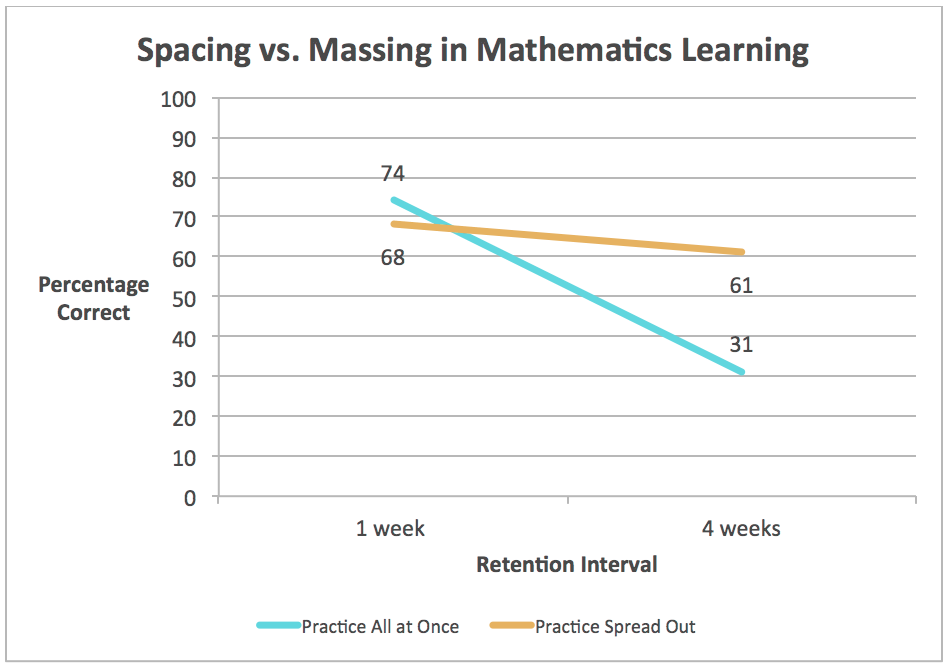
Here’s an example2. Hal Pashler’s research team had students come to his lab to learn an unusual math procedure, and practice it by doing 10 problems. A week later, half of those students returned to take a quiz on this procedure; the other half of the students took the same quiz…a MONTH later.

Then, Pasher had another group of students learn the same unusual math procedure—which they practiced by doing 5 problems (not ten, five). They all returned a week later, and did five more practice problems. A week later, half of those students returned to take the quiz; the other half of the students, again, took that quiz a month later.

So, both groups studied the same procedure, and did ten practice problems. The only difference: the schedule on which they did that practicing. Half of them did all the practice at once; the others spread their practice out.

Which group did better?

AW Graph2

To put that picture into fewer than a thousand words: by spreading their study out, the second group remembered twice as much as the first group did.

Why did this technique work? Simply put, the second group had time to forget. The first group spent all their time learning. The second group learned, and then forgot, and then learned again. The forgetting benefitted ultimate remembering.

Two serious problems, however, might interfere with our ability to put this research result to practice.

Problem number 1: the students.

Pasher’s research result feels intuitive to most teachers—we’ve always known its’s better to spread practice out over time—but it feels profoundly counter-intuitive to students. They feel deeply in their gut that they should practice, practice, practice RIGHT NOW.

To help students see the benefits of spacing their practice, I regularly show them Pasher’s study. Students LOVE the idea that they can double the amount they remember (61%, instead of 31%) without doing any more practice problems.

Problem number 2: the syllabus.

Although “The Spacing Effect” sounds like a good idea when I think about any one topic, it leads to a potential problem with my syllabus. In the old days, I’d teach one topic on Monday, and then have my students practice that topic Monday night. On Tuesday we’d do the next topic, and they’d practice it on Tuesday night. In short, my syllabus looked like this:

 
Monday
Tuesday
Wednesday
Thursday
Friday
In Class
Topic A
Topic B
Topic C
Topic D
And So On
Homework
20 A Problems
20 B Problems
20 C Problems
20 D Problems
And So Forth

However, if spread my practice out—perhaps by doing 5 problems per topic each night—my new syllabus will look like this:

Monday
Tuesday
Wednesday
Thursday
Friday
In Class
Topic A
Topic B
Topic C
Topic D
You
Homework
5 A Problems
5 A Problems
5 B Problems
5 A Problems
5 B Problems
5 C Problems
5 A Problems
5 B Problems
5 C Problems
5 D Problems
Get
The
Idea

The result: Thursday’s homework is a mess. It seems entirely possible that Spacing benefits learning when you do it with one topic in the psychology lab, but that—when teachers try it in the classroom—the muddled syllabus might undermine all the benefits that Spacing should provide. In brief: Spacing Good, Muddling Bad.

Researcher Doug Rohrer has investigated this question, and here’s what he found3.

He had one group of students come to his lab to learn four unusual math procedures. These students read one tutorial, and did practice problems for that procedure; they then read the next tutorial, and did those practice problems, and so forth.

Topic A
Topic B
Topic C
Topic D
A Practice Problems
B Practice Problems
C Practice Problems
D Practice Problems

Another group read all four tutorials, and then did the same practice problems. However, their practice problems were all jumbled together:

Topic A
Topic B
Topic C
Topic D
B
D
A
C
D
B
C
A
C
B
A
D
A
C
D
B

You can see that the first group looks like my first syllabus: nicely organized; the second group looks like Thursday night on my second syllabus: a jumbled muddle. (Rohrer, more politely, calls this second structure “interleaved.”)

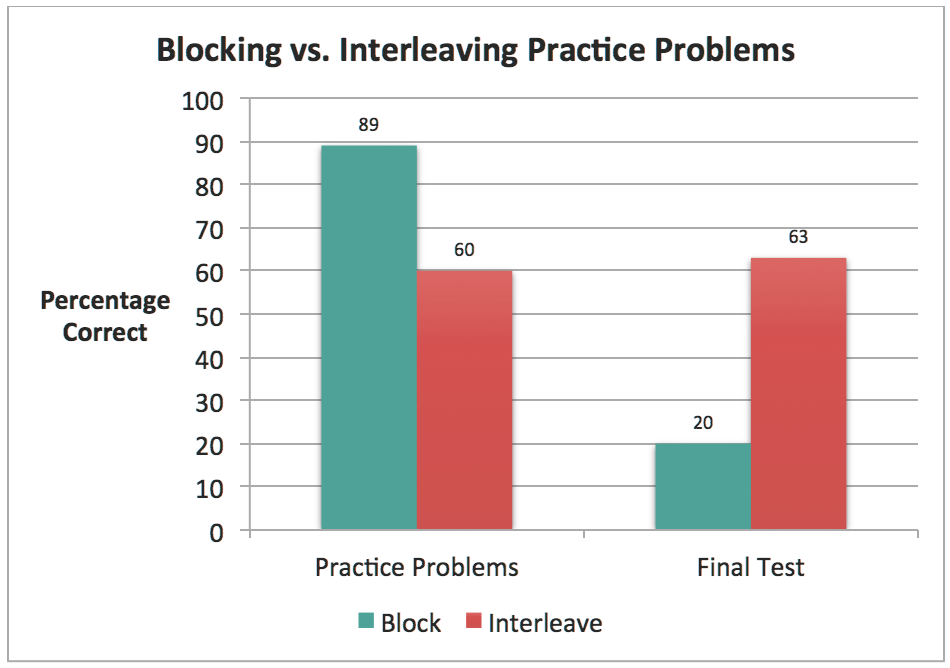
When it came to the practice problems, as I feared, the students in the jumbled group didn’t do very well: they got 60% of the problems right, compared to 88% in the traditionally organized group.

However, what happened when Rohrer’s groups came back two weeks later to take a test? The jumbled group, once again, remembered about 60%. The traditionally organized group remembered 20%.

Yes, 20%. Their score fell 66% in two weeks.

AW graph1

Why did that happen?

Two ideas seem most plausible.

First: Rohrer’s first group learned the four math procedures, but they didn’t practice deciding when to use each one. Because their practice problems always aligned with the technique they had just practiced, they never had to figure out when to use which one. So, two weeks later, they struggled to know which equation to use.

Second: Rohrer’s group had more opportunities to forget. Because their practice problems required them to switch from technique to technique, they never could get into a groove. Each problem, they had time to forget the techniques they weren’t practicing, and so had more opportunities to remember those techniques anew.

These two research pools lead to these conclusions: spacing benefits learning (because it allows forgetting). And, spacing requires a jumbled/interleaved syllabus—which also benefits learning (because, again, it allows forgetting).

A final note about research. The “Spacing Effect” is very well documented, and at this point is not controversial. The benefits of interleaving, however, have been shown by fewer studies; and some of the studies with high-school aged students have been equivocal1. But this much is clear; the combination of spacing & interleaving leads to more learning than the traditional syllabus.

Because, as you now remember, forgetting can help you learn.

References & Further Reading

  1. Dunlosky, J., Rawson, K. A., Marsh, E. J., Nathan, M. J., & Willingham, D. T. (2013). Improving students’ learning with effective learning techniques promising directions from cognitive and educational psychology. Psychological Science in the Public Interest14(1), 4-58. [Paper]
  2. Pashler, H., Rohrer, D., Cepeda, N. J., & Carpenter, S. K. (2007). Enhancing learning and retarding forgetting: Choices and consequences. Psychonomic bulletin & review14(2), 187-193. [Paper]
  3. Rohrer, D., & Pashler, H. (2010). Recent research on human learning challenges conventional instructional strategies.Educational Researcher39(5), 406-412. [Paper]
  • Brown, P., Roediger, H. L., & McDaniel, M.A. (2014) Make it stick: The science of successful learning. Cambridge: The Belknap Press of Harvard University Press. [Book]
  • Carey, B. (2014). How we learn: The surprising truth about when, where, and why it happens. New York: Random House. [Book]

Default Image
Andrew Watson
Andrew Watson

Remember Kid

When teachers say we want our students to learn, we might also say we want them to remember; after all, if I’ve learned something, I can remember it later on. Sadly and surprisingly, there’s a curious danger to remembering: remembering can cause you to forget.

Yes, you read that right. The wrong kind of remembering causes forgetting.

Imagine the following mental exercise—a mental exercise that resembles many research studies1:

To start, you study a list of words in four different groups—say, Animals (dog, cat), Instruments (guitar, violin), Foods (pizza, steak), and Furniture (sofa, table). After a while, you recall half of the words in two of the groups. For example, in the Animal group, you recall the word “dog” (but not “cat”), and in the Foods group, you recall the word “pizza” (but not “steak”). And you don’t recall any words in the Instrument or Furniture groups.

When I test you on all these words several hours later, there are three logical categories.

First, there are the two groups of words you didn’t recall all: Instruments and Furniture. You’re likely to remember—perhaps—50 % of those words.

Second, there are the words and groups you did recall: the word “dog” in the Animal group, or “pizza” in the Food group. Because you recalled these words, you’re likelier to remember them, so your score will be higher—say, 75%.

Third, there are words that you didn’t recall (“cat,” “steak”) even though you recalled other words in Animal and Food groups.

Take a moment to ask yourself: what percentage of words in this 3rd group are you likely to remember?
Perhaps—because you practiced their groups—you’ll remember them at the 75% level. Or perhaps—because you didn’t practice these specific words—you’ll remember them at the 50% level.

It turns out both answers are wrong. You’ll remember even fewer of those words: say, 40%.

Why? Because practicing some of the words in the Animal and Food categories makes it less likely you’ll remember the un-practiced words. In other words, recalling some of the words prompts you to forget the words you didn’t recall.

The wrong kind of remembering caused you to forget.

In the neuroscience community, there is an active debate about the mechanisms that cause “retrieval-induced forgetting.”2,3 And while that debate is fascinating, it doesn’t really help teachers answer our constant question: “what should teachers do in the classroom with this scientific information?”

I haven’t read any research that addresses this question directly. (More precisely: I don’t remember having read any research that answers it; perhaps I read it, and forgot the source.) But I think the potential dangers of retrieval-induced forgetting (often abbreviated RIF) should shape our practice in very specific ways—in particular, the way we review.

Here’s an example. In yesterday’s class, my students discussed the five ways that the French and Indian War lay the foundation for the American Revolutionary War. To begin today’s class, naturally, I ask my students what conclusions we reached. One student calls out: “The French and Indian War cost a lot of money, and the British government decided to tax the colonies to pay for it. Those taxes helped spark the revolution.” Exactly so. Another student adds to the list: “George Washington gained essential military training and a cross-colony reputation for bravery.” Because we’ve gone over these two key points from yesterday, I assume my students will be prompted to remember the other three. Confident in this assumption, I move on to today’s new topic…

But there’s a problem here. Yesterday, my students got a list of five key points; today, we began class by reviewing two of them. I hoped—in fact, assumed—that my two-item review will help them remember the other three points. However, if the RIF research is true, then my two-item review will in in fact make it less likely that the students will remember the other three items. Because they practiced two of the examples in this group (“ways that one war set the stage for the next”), they are less likely to remember the un-practiced examples in that group.

When I first read this research, and started thinking about my own teaching practice, I realized with increasing alarm how often I review this way. If we studied ten vocabulary words yesterday, I’ll prompt students to recall two or three. If we looked at eight subject-verb agreement rules, I’ll asked them to jot down two, and discuss them with a partner. Of course, teachers must help their students review the material they learn, but if the first review is incomplete, we may very well be reducing—not increasing—the long-term likelihood that our students remember all the information.

In my own teaching, the RIF research has led to this guideline: the first two or three times I go over a topic, I make sure to cover all of the material that is a) conceptually related and b) equally important:

  • “Conceptually related”: RIF results from partial review of conceptually related information only; it influences Animal and Food words, not Instrument and Furniture words.1 For this reason, I don’t need to review an entire lesson—just the logically connected pieces of it. When I go over five essentials for a strong topic sentence, I don’t also need to review the highlights of “Young Goodman Brown.” We discussed both topics on the same day, but our discussion of the short story was conceptually distinct from our discussion of effective writing.
  • “Equally important”: when we go over all five ways that the French and Indian War led to the Revolutionary War, I don’t need to go through the detailed specifics; they’re not as important as the main concept. If I think of my lesson plan in an outline, I should cover all (or none) of the points on the same level of that outline.

One final danger to consider: student directed review might be especially prone to RIF. If students come up with their own list of key terms to remember, for example, their incomplete list might prompt them to forget the examples they didn’t include. As teachers, we need to find mechanisms to ensure that student generated review covers all equally important information.

Of course, research into RIF continues, and we don’t yet completely understand how and why it happens. For teachers, the key point to keep in mind is this: whenever we prompt our students to review, we must be sure that RIF doesn’t cause them to forget what we want them to remember.

References & Further Reading

  1. Jonker, T. R., Seli, P., MacLeod, C.M. (2012). Less we forget: Retrieval cues and release from retrieval-induced forgetting. Memory & cognition 40(8), 1236-1245. [Paper]
  2. Dobler, I.M. & Bäuml, K.T. (2013). Retrieval-induced forgetting: dynamic effects between retrieval and restudy trials when practice is mixed. Memory & cognition 41(4), 547-557. [Paper]
  3. Mall, J.T. & Morey, C.C. (2013). High working memory capacity predicts less retrieval induced forgetting. PLOSOne 8(9), e52806. [Paper]
  • Johansson, M. et al. (2007). When remembering causes forgetting: Electrophysiological correlates of retrieval-induced forgetting. Cerebral Cortex 17(6), 1335-1341. [Paper]